
One of the biggest challenges for AI in business is working reliably with data, because large language models (LLMs) are designed for language rather than numbers.
Fabric IQ changes that by giving AI a business-friendly understanding of your data, not just access to tables and figures. Chatbots and agents often struggle with numerical questions because they lack context about metrics and relationships between data points.
Fabric IQ solves this with an ontology layer that explains the data in terms an LLM can understand, making responses more accurate, consistent and relevant. This allows organisations to apply AI to business data to build and publish data agents, such as in Teams, so people can ask natural-language questions and receive trusted answers without specialist data expertise.
What is Microsoft Fabric IQ?
Microsoft Fabric is a unified data platform, covering the Microsoft tools for data storage & integration (Think lake-houses, warehouses, event-houses and data factories). Announced in Microsoft Ignite 2025, and now available in preview, Microsoft Fabric IQ is the missing piece of the puzzle which transforms how Fabric works.
Microsoft Fabric IQ adds a semantic intelligence layer to existing data solutions transforming a unified data platform into a comprehensive Intelligence platform, with significant advancements in how enterprises understand and act on business data. Fabric IQ combines analytical, time-series and location-aware data with operational systems into a single, business-aligned model, allowing for real-time, informed decisions. Fabric IQ is laser focused on what your business data means.
In this blog we will explain Fabric data agents and the essential Ontology data model. We will consider the differences between Fabric Semantic models & ontologies and explain where and how you can publish Fabric Data agents and share them across multiple users to achieve wide scale usage across an organisation. We will also provide some pricing information for Fabric IQ.
If you’d like to discuss what Microsoft Fabric IQ is, what tools and features are included in Microsoft Fabric IQ, how pricing works in Microsoft Fabric IQ and more then please contact us for a free discussion with one of our Certified Azure technical consultants:
Overview of Microsoft Fabric IQ
Microsoft Fabric IQ was announced as a public preview at the end of 2025. It is a three-part Microsoft “intelligence layer” that provides enterprise-wide context for AI agents:
- Work IQ (M365 context) – what people do
- Fabric IQ (data semantics) – what the business means
- Foundry IQ (knowledge management) – where the right knowledge lives
This blog focuses on Fabric IQ.
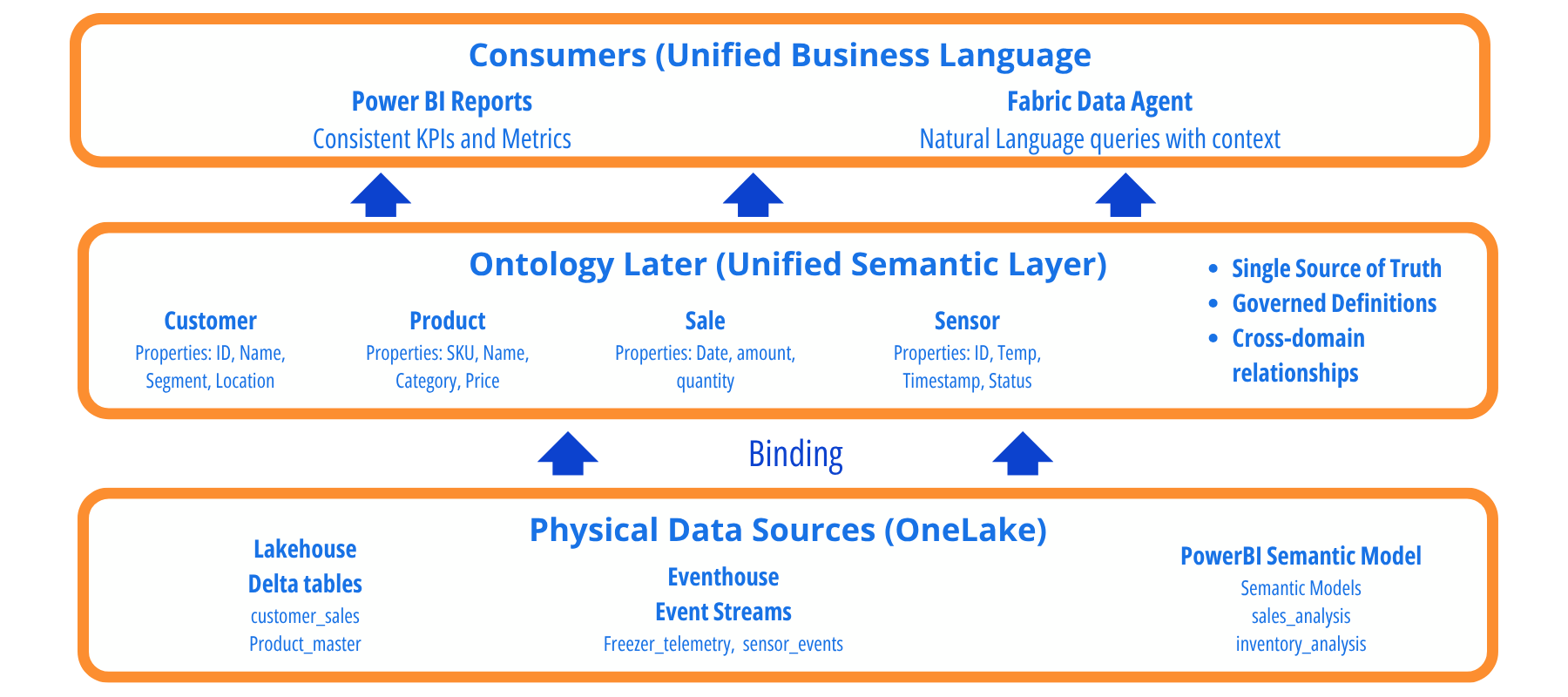
Fabric IQ is a semantic layer for unifying data sitting across Microsoft OneLake and contextualizing it according to the language of your business. The data is then exposed to analytics, AI agents, and applications with consistent semantic meaning and context.
Microsoft Fabric unifies your data, but with the additional of Fabric IQ it is now possible to understand what that data really means for your business.
Fabric IQ unifies all your business data (whether that is operational data, analytical data, geo-spatial, real-time streaming data, etc), and most importantly provides meaning and context of your data to AI Agents.
Fabric IQ provides a semantic foundation that unites data, business meaning and action into a single unified view of your organisation. This enables your team to leverage AI to ask questions, reason and act in natural language, and empowers AI operations through AI Agents to run your business.
You can also connect Fabric IQ with Foundry IQ which is the managed knowledge and agentic retrieval layer within Azure AI Foundry.
What licence do I need to use Microsoft Fabric IQ?
Before you can explore the end-to-end capabilities of Microsoft Fabric IQ, you need a Fabric capacity, and you also need these Tenant settings:
- Microsoft Fabric Capacity (starting from F2 SKU).
- Fabric Admin Portal
- Enable Copilot and Azure OpenAI tenant switch
- Enable Ontology item (preview)
- User can create Graph (preview)
- Users can create and share Data agent item types (preview)
- Users can use Copilot and other features powered by Azure OpenAI
- Data sent to Azure OpenAI can be processed outside your capacity’s geographic region, compliance boundary, or national cloud instance
- Data sent to Azure OpenAI can be stored outside your capacity’s geographic region, compliance boundary, or national cloud instance.
What is the importance of Ontology in AI?
Users have been working with data for many years, however data by itself doesn’t mean a lot unless we apply a context to it. We are used to seeing reports and even dashboards to understand what we can do with data. But how do we enable this context, meaning or experience of data handling to AI Agents? How do we provide the knowledge, experience of handling data to AI Agents? This is where Ontology comes in. Ontology is a way to apply context or meaning to our enterprise data and make it understandable to AI Agents and humans. Ontology is a shared context layer in Fabric that can be used by AI or humans.
Ontology allows you to define entities (like customer and locations, carriers, product categories), properties (like a customer’s name and email), and relationships (like customer places order).
Once you define your ontology, you bind the entity type definitions to real data.
What is binding in MS Fabric IQ?
A binding tells Fabric IQ exactly which table, column, or event stream in your Lakehouse, Warehouse, or Power BI semantic model contains the data for that entity. If your CRM, billing platform, and marketing systems all have customer records in different places, bindings map them into a single, cohesive “Customer” entity.
What is the importance of Relationships for Fabric IQ?
A relationship in Microsoft Fabric IQ is a formal connection established between two or more business entities within your ontology. So, when you ask a Fabric Data Agent a question like “Which customers bought our top product?”, it uses relationships to automatically navigate from the Customer entity, through the Order entity, to the Product entity.
What’s the difference between Ontology and a Semantic Data Model?
Ontology at the outset looks like a Semantic data model, but it adds business context and meaning to enable LLMs to understand your data. Here are few differences between Ontology & Semantic Data model:
Binding: with Ontology, you can connect to various dispersed data sets (such as operational data, analytical data, geo-spatial data and real-time streaming data). You can also connect datasets from various business domains where data in each domain can have its own data definitions and data types.
Ontology does the heavy lifting for mapping data types from various data sources, defines identity keys, maps columns to properties and create relationships across multiple entities. Data from various business domains or data sources are reconciled into a single coherent business entity.
In data warehouse or semantic data models, the data quality checks, data integration and data transformation are all performed using various data tools and must be designed and built by skilled data architects or developers
Organising Data vs Contextualising Data
Semantic data models translate complex raw data (tables, files) into a simpler business friendly format and thereby are useful for organising data for reporting, consistency, and deterministic calculations.
Ontologies prepare the framework and context of business data with the help of Entities, Bindings, attributes, relationships, Agent Instructions, Data source instructions and definitions. This allows LLM models and agents to think and use new information without needing explicit programming for every scenario
Consumption
Semantic data models can be consumed in BI reporting, dashboards.
Ontologies can be consumed in Data Agents which can then further be consumed by M365 services such as PowerBI Copilot, Copilot studio, AI Foundry and Python SDK.
What are Fabric Data Agents?
Data agents in Microsoft Fabric enable you to build your own conversational Q&A systems by using generative AI. Fabric data agent enables your team to have conversations using plain English-language questions about the data that your organisation stored in Fabric OneLake and receive relevant answers. This way, even people without technical expertise in AI or a deep understanding of the data structure can receive precise and context-rich answers.
In Agentic application architectures on Microsoft Fabric, data agents serve as the conversational analytics component, connecting to governed data in OneLake through lakehouses, warehouses, semantic models, and KQL databases in multi-agent solutions.
The Fabric data agent uses large language models (LLMs) to help users interact with their data naturally. Below are the key processes in Fabric Data Agent:
- Question parsing and validation
- Enforcement mechanisms:
- Data source identification:
- Tool invocation and query generation:
- Natural language to SQL (NL2SQL) for relational databases (Lakehouse/Warehouse).
- Natural language to DAX (NL2DAX) for Power BI datasets (Semantic Models).
- Natural language to KQL (NL2KQL) for KQL databases. NL2KQL can use KQL user-defined functions (UDFs) when they’re available in the selected databases.
- Microsoft Graph queries for organizational data accessible through Microsoft Graph.
- The selected tool generates a query based on the provided schema, metadata, and context that the agent underlying the Fabric data agent then passes.
- Query validation
- Query execution and response
What are the four main components to enhance your Fabric Data Agent?
- Data agent instructions – Data agent instructions guide the agent in generating accurate and relevant responses to user questions. These instructions can specify which data sources to prioritise, outline how to handle certain types of queries, and provide helpful terminology or context for interpreting user intent.
- Data source instructions – data source instructions are applied when the agent routes a question to a specific data source. These instructions provide the context needed to construct precise queries—whether in SQL, DAX, or KQL—so the agent can retrieve accurate information
- Data source description – Data Source descriptions allow creators to provide high-level context about each data source so the Data Agent can intelligently route questions.
- Data source example queries – Example queries, also known as few shot examples, are used by data agent tools to improve the quality of generated queries. They allow creators to pass example query logic that the agent can reference when forming a response.
What are the Fabric Data Agent Publishing options?
Microsoft Fabric data agents allow you to interact with organisational data via natural language, merging the capabilities of OneLake with generative AI. They can be consumed across several native Microsoft ecosystems, custom applications, and developer frameworks.
You can consume Fabric data agents through the following integrations:
- Consume a Data agent through AI Foundry
- Consume a Data agent in Microsoft 365 Copilot
- Consume a Data agent in PowerBI through Copilot
- Consume a Data agent in Copilot Studio
- Consume a Data agent through Python SDK
- Consume Fabric data agent as a model context protocol server
How much does Microsoft Fabric IQ cost?
Microsoft Fabric IQ does not have a separate standalone license. It is an additional feature available in MS Fabric and available to users who already have active Microsoft Fabric Capacity. Pricing is based entirely on your compute capacity consumption and data storage.
Microsoft Fabric IQ components are as follows:
- Microsoft Fabric Capacity: Simplified purchasing with a single pool of compute for every workload that powers all capabilities in Microsoft Fabric, from data modelling and data warehousing to business intelligence and AI experiences.
- Billed as per SKU (capacity units) and the lowest SKU is F2 (2 Capacity Units) and the cost is £235.765/month.
Note: Reservation pricing is available for all SKUs
- Storage: A single place for storage of all data formats
- Billed per gigabyte (GB) and the cost is £0.0185 per GB per GB
What next?
Compete366 are the Azure and M365 experts for UK SMBs with in-house IT teams.
Our proposition is unique – if you sign up with Compete366, we guarantee that you’ll pay the same as when you subscribe directly with Microsoft for Azure or M365, but with the added benefit of free ongoing expert advice and guidance for your in-house IT team from our dedicated team of experienced technical consultants.
So, if you’d like to discuss how Microsoft Fabric IQ could work in your organisation, how pricing works, or need more information about AI powered data analytics then please contact us for a free discussion with one of our Certified Azure technical consultants:
If you’ve enjoyed reading this Blog Post, then sign up to receive our monthly newsletter where we share new blogs, technical updates, product news, case studies, company updates, Microsoft and Cloud news.
We promise that we won’t share your email address with other business or parties, and will keep your details safe. You can choose to unsubscribe at any time.
Related Posts
Contact our Microsoft specialists
Phone or email us to find out more – or book a free, no-obligation call with our technical consultants using the contact form.
“It’s great to work with the Compete366 team, the team members are really knowledgeable, helpful and responsive. No question is too difficult for them. They have really helped us to manage our Azure costs and ensure we have the right environment. When we bring a new customer on-board we can scale up immediately via the Azure portal and quickly make environments available to our customers.”
“We also find that there’s never a heavy sales pitch from them – they are technically focused and recommend what’s right for us.”
“We had great support from the Compete366 AVD expert, who was really helpful, and guided me through options to tackle issues that arose.”
“The great thing about our AVD set up is that we have a custom set up for each project which Compete366 showed me how to do. And with the scalability and flexibility of AVD – we can meet clients’ expectations and get project users up and running more quickly.”
“We were immediately impressed with the advice that the Compete366 specialists in Azure Architecture were able to provide. This was all new to us and we really needed some external expertise that we could use to get our questions answered. The beauty of working with Compete366 is that we transferred our Azure consumption to them, and at the same time received all of their advice and guidance free of charge.”
“Working with Compete366 has been like extending our own team – they are extremely and easy to work with. Right from the outset, it was clear what was on offer – everything was presented to us in a straightforward and uncomplicated way. They also provided just the right level of challenge to our developers and saved us time and money by suggesting better ways to implement our infrastructure.”
“Compete366 were able to help us leverage some useful contacts in Microsoft. We really value the expert advice and guidance that they have offered us in setting up a highly scalable infrastructure. We are also setting in place a regular monthly meeting which will allow us to further refine our architecture and ensure we keep on track as our requirements grow and change.”
“I have been delighted with the migration, where my team worked very hard, supported by expert advice from Compete366, and achieved everything in the timescale we had set out. Compete 366 made sure that we didn’t make any expensive mistakes, and guided us through the process”